
Most AI workshops start with the tools. Forty of them, on a slide, with logos. You leave with a notebook full of names and absolutely no idea which one to open on Monday.
I know, because I sat through a few. And then I went home and kept running my business from memory, the way I had been all along.
So when I built my own AI workshop for small business owners, I did it the other way round. It starts with what your business is asking of you. Then it works back to the tool.
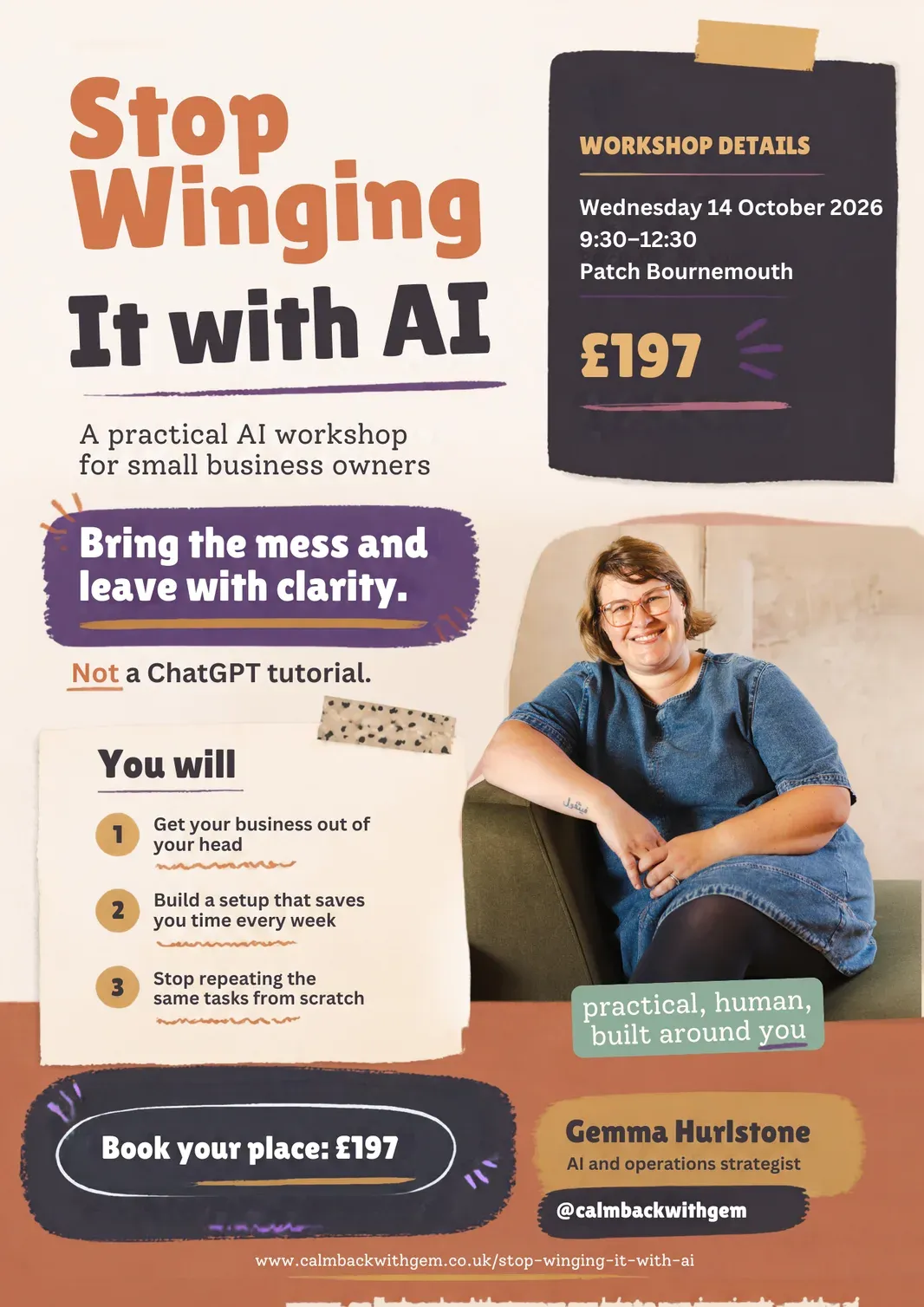
It’s called Stop Winging It With AI, and the next one is on Wednesday 14 October at Patch Bournemouth.
Your business needs too much of your brain
Here’s who I built this for.
You’ve got clients. Work is coming in. Starting the business isn’t the problem. The problem is that running it still depends on you remembering everything.
Who needs chasing. Where that file is. What you promised that woman on the phone on Tuesday. What happens when an enquiry lands at 9pm and you’re in the bath.
You’ve opened ChatGPT. It was fine. Everyone else’s seems better than yours. You type the same thing into three places every week and you know it.
I was her. Two businesses, two kids, a late ADHD diagnosis, and I was trying to run the whole lot from memory. Chasing invoices from a shitty notebook. The business now remembers so I don’t have to, and what I built to get there is what I teach in that room.
What a good AI workshop for a small business should actually do
If you’re weighing up any AI training, mine or anyone else’s, here’s what I’d look for.
It should be about your business, not the tools. If the agenda is a tool tour, you’ll leave impressed and change nothing.
You should build something with your real information. Not a made-up example about a fictional bakery. Your enquiry email. Your messy to-do list. Your call notes.
Someone should tell you when AI isn’t the answer. This is the bit most trainers skip, because they’re selling AI. If you’re already in chaos, AI makes you more chaotic. Some of what’s on your list needs stopping, not automating. I wrote more about that in AI is not always the answer, says the woman who sells AI.
It should cover what not to upload. Free AI accounts can use what you type to train the model. If nobody mentions GDPR in the first hour, that’s a red flag. (Here are the three GDPR mistakes I see founders make with AI.)
You should leave with one thing working. Not seventeen ideas. One.
How the morning runs
Three hours. 9:30 to 12:30. Ten people round a U-shaped table, laptops open.
Understand it. The first part is the bit nobody ever explained properly. What AI is good at, what it’s bad at, why it makes things up, and why giving it context beats any clever prompt you’ll find on Instagram. In normal words. No jargon.
Make it yours. Then your laptop. We set your AI up around you and your business, in your words, so it stops sounding like a stranger. Then we test it. Same real question, before and after. That “oh” moment, when it suddenly sounds like it knows your business, is the whole workshop.
Put it to work. The last part is the method I use with every client.
- Get it out. Everything your business relies on you to remember, find, chase or redo, on paper.
- Sort it out. Every item gets one of five: stop it, simplify it, systemise it, give AI a role, or keep it human.
- Set it up. You pick one job that passes the test, build it with your real information, run it, fix it and save it somewhere you’ll find tomorrow.
At 12:22 I go round the room and ask everyone one question: what was AI not helping you carry at 9:30 that it’s helping you carry now?
Everything before that is in service of your answer.
What you’ll leave with
Three things. Not seventeen.
- You’ll know what to give AI, and what to keep.
- Your AI will understand your business, because you’ll have set it up properly.
- One repeated job will be working, tested with your real stuff and ready to use the next morning.
That job might be turning a client call into an action list and a follow-up email. Or a voice note of loose ends into this week’s plan. Or a real enquiry into a reply you’d actually send.
Who it’s not for
If you want a tour of forty tools, a prompt-writing masterclass, or someone to automate your whole business before lunch, this isn’t it. None of that happens here.
And if you get to the sorting bit and realise your problem is bigger than one task, that’s not a failure. That’s the diagnosis. I’ll tell you so, kindly, and you’ll still leave with something working.
The details
- What: Stop Winging It With AI, a practical AI workshop for small business owners
- When: Wednesday 14 October 2026, doors 9:30am, we start 9:45, out by 12:30pm
- Where: Patch Bournemouth, The Writer’s Room, 1st Floor, Bobby’s, Commercial Road, Bournemouth BH2 5LP
- How many: ten seats, twelve at a squeeze
- Price: £197, tea and coffee included
- Bring: a laptop with ChatGPT or Claude logged in (free is fine) and one real mess
Show up, do the work, and if you genuinely got nothing from it, I’ll refund your ticket. That’s the only guarantee I make, because it’s the only one I control.
Book your seat at Stop Winging It With AI
Questions people ask
Do I need to be good with AI? No. Most people in the room have opened ChatGPT a handful of times and felt a bit thick. You need to be honest about what’s in your head. I’ll do the rest.
Do I need a paid ChatGPT or Claude account? No. Free works for the day. I’ll tell you on the morning whether paying is worth it for you, and sometimes it isn’t. Not sure which to pick? Here’s my take on Claude vs ChatGPT.
Is this only for Bournemouth businesses? It’s in Bournemouth, so it suits anyone around Poole, Christchurch and wider Dorset who’d rather learn in a room than on another Zoom.
What if my “one thing” is too big? Then we’ll find the smaller one sitting next to it for the day, and you’ll go home knowing exactly what the bigger one needs.
You are not behind on AI. You’ve just never been shown what matters.